Guest houses9.7
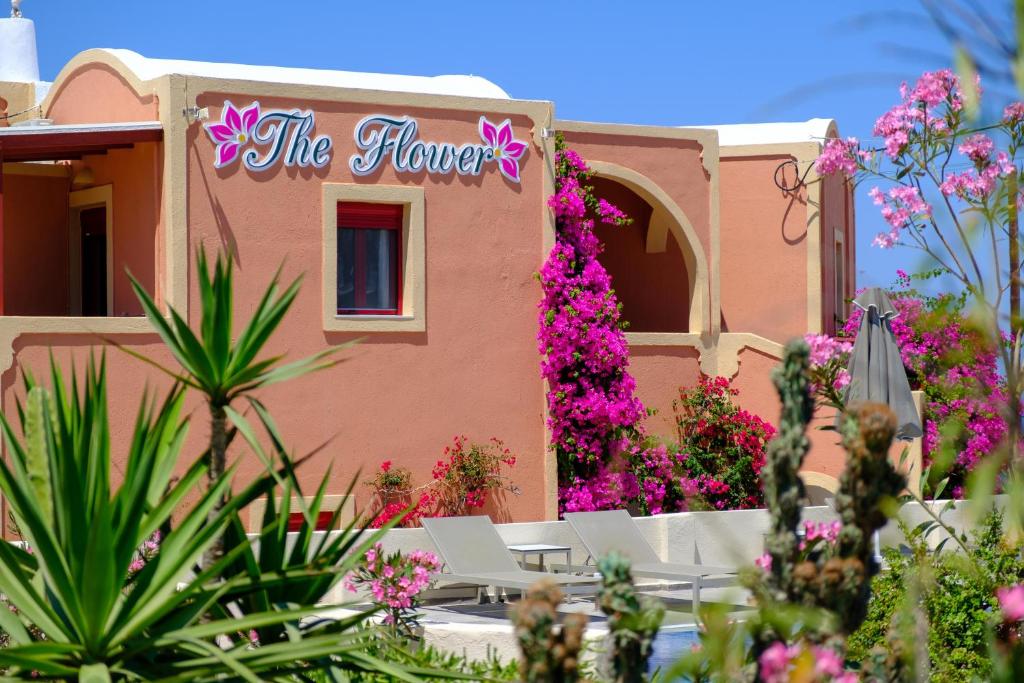
Pension The Flower
Oia · Cyclades
Guest house in Oia, Santorini, with a seasonal pool, garden and free parking, and rooms with sea views and a balcony or terrace.
Exceptional · 457 reviewsSee prices
4 places to stay
Oia lies at the north-western tip of the island, on the caldera cliff, about 11 km from the capital. It is a seafarers' village: the captains' mansions and cave houses, white, ochre or pink, descend in tiers towards the sea, and since 1976 the settlement has been protected. The sunset from the castle made it famous and brings crowds every afternoon; early in the morning and late in the evening, though, the lanes quieten. It suits couples and those who want to stay a few days in one place, without nightlife.
1–4 of 4
Oia · Cyclades
Guest house in Oia, Santorini, with a seasonal pool, garden and free parking, and rooms with sea views and a balcony or terrace.
Oia · Cyclades
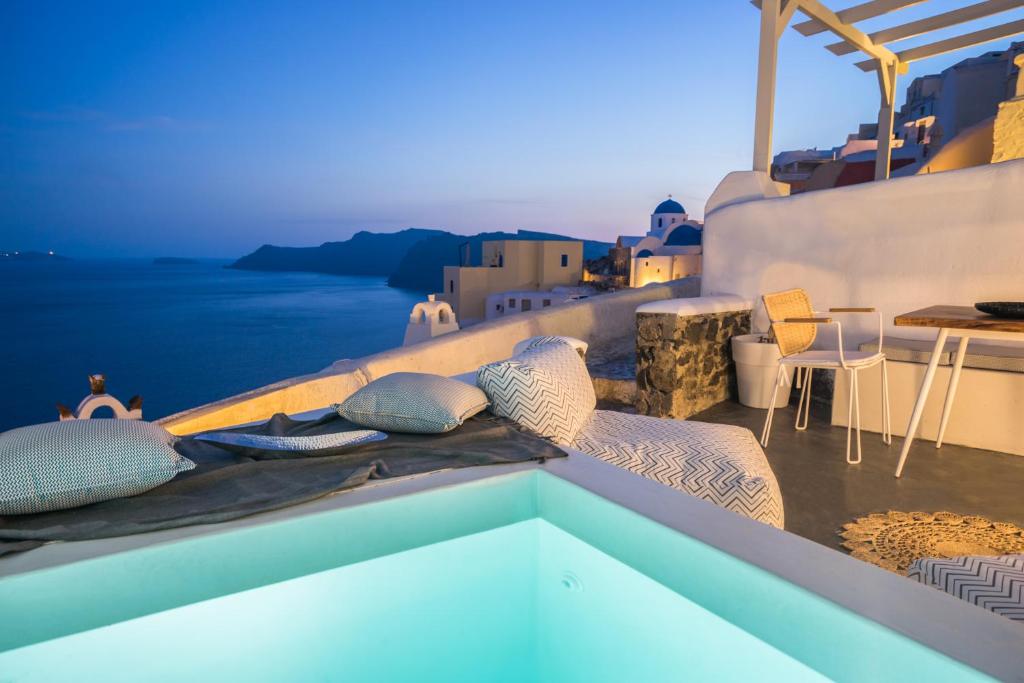
A villa with suites in Oia, Santorini, offering views of the caldera and volcano, private hot tubs and breakfast served in your suite as a takeaway.
Oia · Cyclades
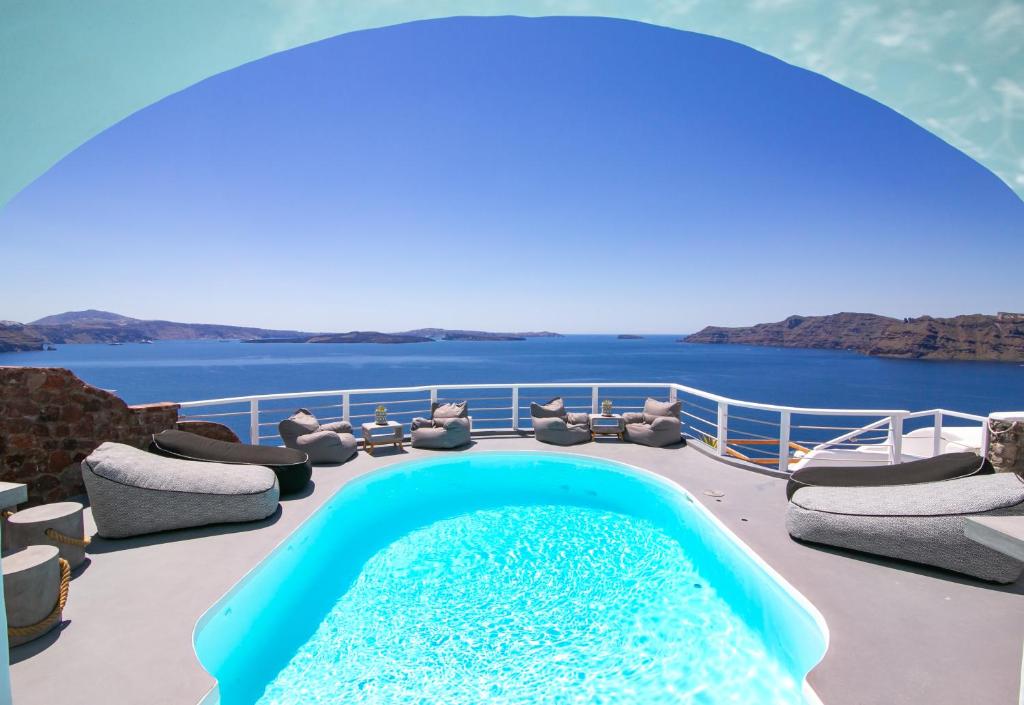
Villas and suites carved into the volcanic cliffs of Oia, with caldera views, a private pool or hot tub, a restaurant and a poolside bar.
Oia · Cyclades
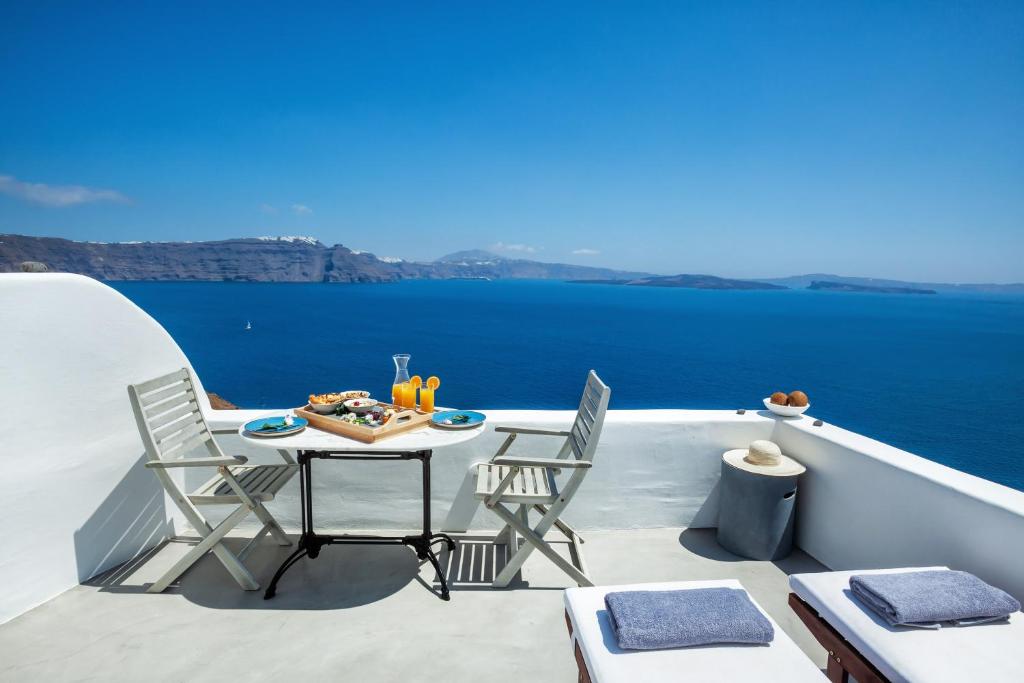
Holiday home in Oia with suites featuring private hot tubs, sea-view terraces and the Naval Maritime Museum 50 m away
Guide to Oia
It was once also known as Pano Meria. Its heyday came in the late 19th and early 20th centuries, when its sailing fleet traded across the eastern Mediterranean; around 1890 it had about 2,500 inhabitants and 130 sailing ships. The captains built two-storey mansions along the ridge, while lower down the houses were dug into the volcanic rock. Steamships, emigration and the earthquake of 1956 emptied the village, which came back to life with tourism.
This maritime history, shared with other Cyclades islands, is told by the Maritime Museum, in a captain's house in the village, with a collection started in 1951 by a local captain. At the highest point, the ruins of the Venetian castle, known as the Lontza or the castle of Agios Nikolaos, were once a lookout over the open sea. The municipal unit of Oia also includes Thirasia opposite, the small island that closes the caldera on the west side of Santorini.
Most accommodation is on the caldera side, much of it in old cave houses with vaulted rooms that stay cool in summer, often with a private terrace or small pool. Watch two things: orientation, because only west-facing places see the sun set, while the rest look onto the caldera and the volcano; and access: ask how many steps separate the pedestrian path from the room and whether there is help with luggage, because for people with reduced mobility or parents with a pushchair the difference is big.
Oia is for those who want to stay, not just pass through: when the day visitors leave, the evening is quiet and the bars are few. It is not convenient as a base for the whole island, though, because it is far from the beaches of the south and the bus always goes via Fira; for something more central, look at Pyrgos. If you want quiet without the caldera, Finikia, about ten minutes on foot, has pedestrian lanes, larger courtyards, views of the sea and the vineyards, and its own sunset.
The main pedestrian street, Nikolaou Nomikou Street, runs through the village along the ridge, with galleries, jewellers and ceramics. Many of the narrow lanes around the blue domes and the rooftops are private spaces: do not climb onto roofs and fences for photographs. For sunset at the castle you need to arrive at least two hours early; a quieter alternative is sunrise or an early-morning walk. July and August are the busiest months, while from late April to June and in September and October there are fewer people.
Below the castle, a few hundred steps lead down to Ammoudi, the small harbour with fish tavernas beneath the red cliffs. There is no sandy beach: those who swim dive from the rocks beyond the last taverna, and only when the sea is calm. The steps have no shade and are uneven, so wear closed shoes; a narrow road also goes down to the harbour, for taxis or cars. Further south, Armeni, Oia's other old harbour, was once a shipyard and today has caiques for excursions and for Thirasia.
Oia is about 17 km from the airport and about 20 km from the port of Athinios, so with luggage a taxi or a pre-booked transfer is the simplest solution. The KTEL bus connects Oia only with Fira and fills quickly after sunset. Inside the village you get around only on foot, and the few car parks on its edges fill early. If you are fit, you can also come on foot from Fira, along the caldera path.